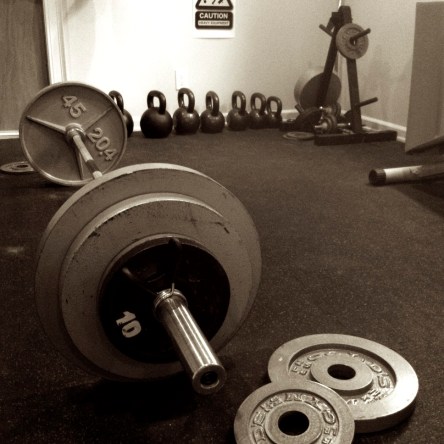
Rock around the Block
February 11th, 2012 Comments Off
So I completed my Deadlifting cycle for a bit. That was a ton of fun. (Actually, if you add all the pounds moved, it was well over a ton, but that involves doing a lot of math, so I’ll just round down)
As I have written before, I use Pavel Tsastouline’s Power to the People protocol for Deadlifting. But I was able to have even more fun with this. Over the summer I had picked up Easy Strength by Pavel and Dan John. Easy Strength is an amazing book that details out how to understand and identify your goals for lifting and training, track progress, and set your programs to hit those goals.
I had read through it twice, and found a great protocol that I thought would fit my Goals (general fitness as opposed to sport specific) and it fit both my skills and equipment. The program worked out to be:
2-week Block Training (for a minimum plan of 10 weeks (5 sets))
Block 1: Single-arm Kettlebell Clean and Presses with Goblet Squats
Block 2: Power to the People Deadlifts
If you aren’t familiar with these these things, I’ll clarify.
Block Training is an old training method (very popular in the Former Soviet Union) where different exercise types are organized into Blocks, with a period of two weeks being the most common. You alternate the blocks over a period of several weeks before changing or moving to something new. Each block would differ from the others by either area worked (say, and Upper body block followed by a Lower body block) or it could differ by exercise type (in my case, a Pressing and Squats block followed by a deadlift block) You can run at a fairly high intensity as you recover from one type of work as you change to the other. Also, it lets you combine things in a way that keeps everything interesting.
Kettelbell Clean and Presses are surprisingly less common that I usually think. While kettelbells are very popular via Crossfit right now, most folks out there are just using them for swings (and typically the American Style over-the-head swing. – I follow RKC methods myself). I favor the C&P because when you are handling a large overhead weight on one hand only, then add the inherent eccentric balance of the Kettlebell, you turn an upper-body exercise into a whole-body lift. You need tight Glutes, core, and lats to achieve a good, straight lift, or you just wobble all over the place.
The Goblet Squat is one that Dan John promotes all the time as a way to dial in clean Squat form. Holding a weight out n front of your body, you pull yourself down into a low squat, with elbows resting on the inside of your kneecaps. It is very hard to get out of alignment with this exercise, and it really dials in great squatting form. The Kettlebell handle is a perfect alignment for the grip in a goblet squat, making it a perfect bookend for pressing sets.
With varying weights, this made my sets look like the following:
Block 1:
Single Arm Presses & Goblet SquatsMonday (16kg x 5, 20kg x 5, 24kg x 5) X 4 sets
Wednesday (32kg x 2, 24kg x 5) X 4 sets
Friday (20kg x 5, 24kg x 5) X 4 setsBlock 2:
Power to the People deadliftsMonday: 185lbs/135lbs
Tuesday: 205lbs/185lbs
Wednesday: 225lbs/205lbs
Thursday: 215lbs/205lbs
Friday: 225lbs/205lbs
Saturday: 235lbs/225lbs
After a Kettelbell week I would see if I felt up to adding an extra set for each day. At the end of a lifting week I would dial back 20 pounds, then add 10 each day. If the set felt too hard, I dialed back a bit.
This progressed fantastically! By the last Kettelbell week, I could get in 5 solid sets, and I was on track to break through a deadlift of 300 pounds. A few days before my cycle completed, I racked up 285 pounds to the bar.
In proper form, I made two excellent pulls. On my third pull, elves snuck in and glued the weights to the floor.
I mean, the bar didn’t move at all.
I was at my body’s limit, so I cut it short. I was well past my Personal Record, I had finished 9 weeks of solid, intense training, made amazing gains, and had no injury. So when my body said stop, I listened.
I took the next two weeks to recover with walking and some light bodyweight. Then is is on to the next challengeā¦
On Pain and Suffering (the good kind)
January 27th, 2012 Comments Off
When I first got the bug up my ass to quit killing myself slowly with the couch, and actually try to get in some kind of shape, I was not motivated by the standard new years resolution, but by the impending doom of MY 40TH BIRTHDAY! It was good motivation.
I had been demotivated from working out so many times in the past, usually because I never saw any results, or I got hurt. Needless to say, this sucked. So I did the thing any OCD-enhanced individual would do, I started reading.
I buried myself in magazines, blogs, books – pretty much everything I could find about effective exercise. Doing some prep work turned out to be a good plan. Through one of my chains of reading I found out about Kettlebells, and the assorted books by Pavel Tsatsouline. In Enter The Kettlebell, There is an entire chapter entitled “It’s Your Fault”.
This was terribly enlightening. The whole section is the opposite of the usual bravado that you read in any fitness writing, and is an admonishment to pay attention and not get hurt. I really hadn’t read that anywhere else, as an explicit fitness topic, and it is one of the things that has kept me buying Pavel’s books.
After that, one of the online friends through the kettlebell forums summed it up better in a single phrase:
“Don’t move into Pain”
Of course, the difficulty in following that advice, is that as you push yourself harder towards a fitness goal, it hurts. You are moving heavier weights, testing your endurance, and frankly, hurting.
It is a fine line between pushing yourself through the hard work, and not injuring yourself. And if you are new at it, it can be a very fine line. For me, fine enough where I ended up almost damaging a tendon in my elbow before I realized that this wasn’t just part of my lifting, but something was wrong. It ended up costing me three months of physical therapy to recover, and probably another three months of starting from scratch.
That was fine. It gave me time to focus and see the difference between stopping before the pain, which is there to warn you about getting hurt, and ignoring the suffering that pushing yourself to the limits causes.
Really, we are actively seeking out that suffering, and trying to drive through it. That’s what makes us stronger – both physically and mentally.
When I did the Livestrong Ride two years ago, it was my first time doing an organized ride of that size. it was 45 miles, of flats, hills, city and back streets. It prepped myself and trained for the distance, but the race day was miserable. It started cold, then once we were part way into the race, started to rain. It was sticky, oily roadspray, with cold, biting winds. my hands froze on the handlebars, and I was sore all over. My lesson to myself as I was on the road was that I could tell that while I was sore, tired, and freezing, I wasn’t actually hurting or in Pain. I was just suffering through a crappy ride. It actually cleared just a bit as I made it to the finish line.
I had nothing left in the end. I could barely walk to the car until I warmed up, but I felt great. The sense of reward and accomplishment was indescribable.
After that experience, I would add an addendum to my earlier advice:
Don’t move into Pain, but feel free to punch Suffering right in the cock.
Ringside at the BULLfight
December 22nd, 2011 Comments Off
One of the things that I really like about social media is the exposure you get to large groups of people normally you wouldn’t be able to interact with. In good times, this allows you to get information and feedback from people but you might find useful and interesting. And in other times, you get to watch them pick fights each other. This is one of those other times.
Two of the big groups I’m exposed to right now are the Kettlebell crowd and the Paleo diet crowd. In both of these groups are having big internal conflicts. Personally, I’m rather enjoying the show. I’m lucky enough to have some of the better minds in all these groups available to me on Facebook either as direct friends, or through their business pages. And for the most part, they’re a smart, professional group of people.
Currently, I’m trying not to take sides in the arguments. I’m still pretty much a novice in all these areas, and I am hoping to learn from these people. But after a while, you can start pick out the wheat from the chaff.
I can see the point of the arguments for both sides in these situations, and usually they simply have a difference of opinion, but generally are moving towards the same goals. In some cases, I can see where one side really has a difficult time explaining its point of view, and that makes me feel like they don’t know what they’re saying in the first place. Or that they are just BS’ing to gather attention.
I might be wrong, but if you don’t know where you stand in the first place, you probably shouldn’t be arguing. It might be fun to watch for the rest of us on the outside, but it ends up being a colossal waste of time and bandwidth. And worse, you look like a real dumbass after a point.
There have always been splits in the Kettlebell community, and this time looks to be not dramatically different. I think that’s fine. Most of the players are arguing more about form, and details, and they tend to be mostly polite and professional about it. I think thats fine. In the end, we are really just talking about picking up hunks of iron, and there can be many successful roads to the same destination in this area. most of these folks seem to get that.
The paleo crowd has been quite a bit different. Since this summer there has been a core argument between the argument of the “Insulin Hypothesis” (too many carbs raise insulin which triggers fat storage) and the now opposing “Palatability Hypothesis”
This palatability hypothesis supposedly says that if food is better tasting you eat more of it in this causes obesity. If you buy into the whole “well it’s all just calories” argument, then this works.
That seems to make sense on the surface, but from an idea like that, all we can really difficult conclude is, “eat really crappy food and then you’ll be healthy!” So far, there doesn’t seem to be a whole lot said about what mechanism is happening (it’s complicated!) or how this is borne out by the evidence; whereas on the insulin hypothesis side, there’s a pretty large volume of writing about what this is and how it works. It might be wrong, and probably is to a certain extent, but at least we know what they’re trying to say.
As I’ve been following this across all the blogs and other media, watching the same small number of people over and over making the same arguments and I feel like they’ve never been very clear. This has frustrated the heck out of me. These are people who I’ve really respected before, and have really appreciated their writing, and now I’m left trying to effectively fill in the blanks on what they’re trying to say, because they’re so outrageously unclear.
If you can’t clearly state your hypothesis, then I suspect that you don’t really have one. It ‘s a bit like the Monty Python sketch with the guy selling arguments. It ends up as contradiction for contradiction’s sake. (I could be arguing with you in my spare timeā¦)
But, maybe I’m wrong. Maybe this will be much clearer once there is some better writing and better arguments on this topic. But I just don’t have a lot of faith in that case. So in the meantime, I’ll keep doing what I’m doing right now. The way I’m eating, and the way I’m lifting, are working pretty good so far. And there’s always room for improvement.
That much will probably never change.
Yank my chain
September 2nd, 2011 Comments Off
This has been mostly a light week for workouts. The deadlifts last week got up to 255 pounds, then I dialed back a bit. One of my first lessons from starting workouts is to go slow, muscles strengthen quick, but tendons much less so, and they heal even slower.
I’ll pick up next week with some new stuff and we will see how that goes.
I’ve also been biking to work a few days each week, that’s 3 miles each way, and that has been a lot of fun, and a nice addition to the workout as well. I finally managed to clean my chain, which made a much bigger difference in my ride than I expected. The bike is much quieter, and shifts soooo much better. It is still a total tank, being an old chromoly frame, with fat 700×38 road tires, but it takes the curbs and potholes well.
I’m glad we are finally getting some summer… in September.
Low compared to what?
August 26th, 2011 § 1 Comment
One of the more annoying things that I have gotten trapped into lately is the low carb fight.
This isn’t because there is some question in my mind about the benefit of reducing carbs in one’s diet. It’s more about the label “low”. Or “high” for that matter.
The labels are much too general to have any meaning.
This came to a front recently when I had an argument about low carb with Yulia, made a general ass of myself (not too hard I might add) and saw then next day that there was a big food fight at the Ancestral Health Symposium about the same topic between Gary Taubes and Stephen Geyunet.
What was interesting about all these arguments was that everyone pretty much agreed on the basics. but in focusing on the details we all got caught up in the wrong points for no reason in particular. A big culprit in this in particular was the term “low”. Likely, because it has no actual meaning.
This is apparent when you look at the arguments of a “low fat” vs a “low carb” diet in any study. None of these studies ever agree on what these terms mean. If you look at what Atkins thinks a “low Carb” diet is (around 15% of calories), and what Ornish thinks low carb is (around 50% of calories) you have a massive gap. Not something you can dismiss at all, but a substantial gap that impacts the entire discussion forward. If you read a headline that says “A Low Carb Diet does Blah Blah Blah”, the first question needs to be, what do you mean by low?
Even without worrying about confounders and other variables in the study, what the hell does “low” mean?
Then best response to any of this that I have seen is the chart from the diet that I like (Primal Blueprint), that gives specific targets in grams. 50-100 is “low” 100-150 is “normal” and 150 + is high. You might not agree with these numbers, but at least they are numbers, not arbitrary words.
I should note, they also seem to work.
But that isn’t even the point. If we all argue with undefined terms, it doesn’t matter what the data might say, because we are all spouting a bunch of gibberish. We need to define our terms, and work the debate from there. Then we can start to agree or disagree and know what the hell the other is actually saying.

Bring out your dead
August 20th, 2011 Comments Off
Well, at the end of last weekend I managed to work my way over to my mom’s house and steal a stack of Olympic weight plates that my brother left in the back porch. Combining those with my own, I now have 325 pounds of weights for my Olympic barbell, which means…
Deadlifts!
Power to the People was one of the first books from pavel that I picked up, but I never had space or equipment to do deadlifts. It was a great book to have in any case, since half of the book is Pavel’s standard discussion on tension, strength, and muscle irradiation. Real fundamental stuff. But now I went back to the book and re-read the whole section of starting deadlifts. The big upside, as mentioned int this book and just about every book on lifting, is that deadlifts are a very natural movement and a safe one at that. You don’t have a bar over your head and the motion isn’t awkward and tricky.
For pavel’s program you combine two sets of 5 pulls each per day, with a set of overhead presses. the book offers a barbel side press, but I’m option for a Kettlebell Military Press instead, as it is a lot safer than swinging a 6 foot bar around inside the room.
Here are this week’s numbers:
Monday: 185lbs/135lbs
Tuesday: 205lbs/185lbs
Wednesday: 225lbs/205lbs
Thursday: off
Friday: 225lbs/205lbs
Saturday: 235lbs/225lbs
These weights aren’t particularly heavy yet, but I am doing a slow progression to keep form and build up to some kind of a wave cycle later on. You can really feel the difference in this exercise vs a lot of the Kettlebell lifts, it is a whole body tension that is hard to do otherwise.
Of course, the massive “clank” as the weights hit the ground is a lot of fun too.

Last Room Done…
July 14th, 2011 Comments Off
Our final room is done in the remodel. The Workout room (was the Wine Room) Did my first workout there last night. Most excellent.
Back to the Grind
April 14th, 2011 Comments Off
I haven’t blogged about fitness or working out all year, and hey, I suck, but deal with it.
Since we started our house remodel, I haven’t been able to work out at home, and have had to go to the Pro Club instead, which is a lot less fun. The people down in the free weight room scare me most days, standing on BOSU balls flailing weights about like a mad flailing thing. I’m surprised most of the time that I don’t get my head caved in.
With that and getting sick for a bit, I really haven’t been regular until the last month or so. At that point, I started working on Military Press ladders with the 28Kg (62 Lbs) kettlebell. I am doing 3 rung pressing ladders. I just went up to four sets each, and am now adding 44lbs snatches in as well. Hopefully I can get up to five sets within two weeks then move up to four rung ladders.
Originally I was hoping I could jump from the 53lbs to the 70Lbs kettlebell, but that just wasn’t going to happen. I can still press the 70lbs bell just fine, but not for enough reps to do ladders.
I also managed to get Yulia a few free passes to the TRX classes by shaming myself in a TRX demo. I might get one of those for home as well, it seems pretty neat.
Good to be back to the workouts, even if it is in a combat zone.
Truck, Truck, Goose!
January 31st, 2011 Comments Off
I had it asked recently, with my rash of fitness and diet posts of late, why I was so wound up about eating right and working out and living so long when, by chance, I could get hit by a truck and die tomorrow. All that work would be wasted.
As I thought about that, I concluded that my fears come from the exact opposite point of view. With the state of medicine that we have today, it really doesn’t matter how we eat, or if we exercise, or for that matter if we get hit by a truck. We have the medical technology today to keep putting ourselves back together again, and most likely every one of us will live to around 100 whether we like it or not.
The question is not the quantity of our years, but the quality.
Turning 40 left me with less of a feeling of “crap, look how much of my life is gone!” and more of “Crap, look how far I have to go and I feel like shit.” The novelty of backaches, heartburn, tight pants, and such had worn thin. And it has taken surprisingly little effort to turn that around.
That and I use the crosswalk and look both ways. Duh.
You are what (not how much) you eat
January 28th, 2011 § 1 Comment
So about five years ago I clocked in at around 240 pounds. It’s pretty easy to get up there in weight if you eat tons of garbage, never exercise, and don’t pay any attention for a few years.
It finally came to my attention when I went to a new doctor after never going at all for years on end, and he pointed out that I was officially in the “obese” category. That kinda sucked. So I did the usual and picked out a diet and went to the gym. The diet that I went with was “The ABS Diet” from Men’s Health magazine, which is a pretty standard “Superfoods” type diet, and it worked OK. The Gym attendance died after a few months when I ended up hurting something or another, and never went back. Just with the diet I was able to get down to around 226 or so.
A year and a half ago I started working out again, but with Kettlebells, and a wholly different method of working out than the standard Gym circuit workouts that I had tried before, and as anyone who knows me is aware of, this has worked out much better, I dropped a lot of fat, put on muscle, and have felt a lot better. My weight moved to around 220, and stayed there.
Just before my Doctor’s appointment this year, I finished a 12-week intensive kettlebell program (Kettlebell Muscle) which was probably the hardest that I have ever worked out. I was eating well and I was lifting more than ever, I was able to press a 70-lbs KB over my head with one arm, so I was ready to smoke my checkup.
The doctor said I was a bit overweight, and my blood numbers showed that my cholesterol was borderline high. He suggested that I take some fish oil and try to get some exercise.
A blood test at Microsoft two weeks later showed the same results.
Needless to say I was REALLY pissed off.
Here I am, working my ass off for a year and a half, eating a recommended low-fat diet, and my weight and numbers are such that my doctor thinks I’m not doing anything at all.
It was at about this point that Timothy Ferriss’ 4 Hour Body came out. This was a pretty cool book, and had a lot of funky and interesting hacks that he tried for his body, and I was willing to experiment at this point. The diet part of his book “The Slow Carb Diet” was worth a try, so both Yulia and I gave it a shot. It was OK, and some weight came off, but it was making Yulia feel really rotten, so I looked at other options.
This is where my OCD really kicked in.
I followed Timothy’s links on his blog for some of the sources for his diet, to see if there was something similar that might work better. I came across a YouTube video of a guy named Gary Taubes on Larry King discussing his book on diet. This was an interesting watch, since he was basically arguing that what most nutritional advice was based on was faulty science. That was a pretty big claim, But I looked up his book Good Calories – Bad Calories and felt it was worth a read.
That was the start of all the annoying posts to Facebook as I burrowed into the data. Working backwards into the various studies, history of the Lipid Hypothesis, related diets and everything. What struck me was how much what was written about low-carbohydrate diets (vs low-fat diets) made sense when looking at my own weight and experience.
So I went to experiment with a diet on this new side of the fence, and picked The Primal Blueprint. It’s a Paleo-style diet which basically recommends to eat fewer (not no) carbs, no sugar, no grains, and cheat once in a while. It wasn’t that different from the Slow-carb diet, and was worth a shot.
I’m down to 206 pounds now, and eating a lot. The difference in how I feel is pretty amazing. My BMI is finally inside the “Normal” range and my fat percentage is dropping again.
I would say that the cognitive leap to this type of eating is as big as the cognitive leap to using Kettlebells for exercise. It is a complete departure from everything that I “knew” had to work in the past, which never worked. At some point you need to trust your personal empirical data, and try something new. This time, it’s been a hit.
Some links:
Gary Taubes “Why We Get Fat” Presentation at the UW
Studies by Steffan Lindeberg and others on the efficacy of Paleo-type diets
Fat-Head – a film on why Super-Size Me was baloney, and pretty funny too.